

Packed into a lunchbox, brought to a party, gifted to loved ones or simply eaten dipped into a glass of milk there is nothing quite like the humble chewy gooey chocolate chip cookie. In fact, people love this baked good on a level few other desserts have ever come close to.
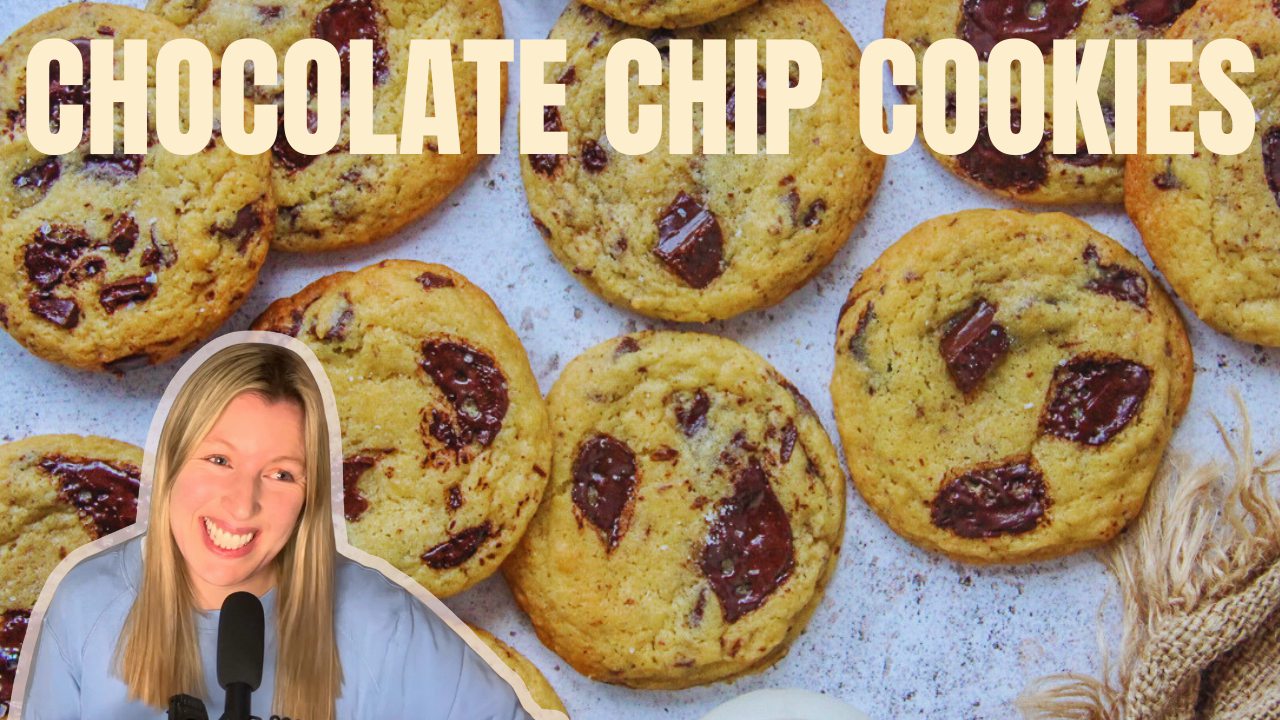
Table of Contents
History of Chocolate Chip Cookies
Biscuits are a type of ancestor to the modern American chewy chocolate chip cookie, but this is quite an American dish with even the word, as per oxford reference; noting it was
Introduced into the USA in the late eighteenth century by Dutch immigrants, and comes from Dutch koekje, a diminutive form of koek, ‘cake’.
By the early 1700s, koekje had evolved to cookie or cookey, and was well-entrenched in New York City, then the nation’s capital—a factor that resulted in widespread use of the term.
As per The Nibble article on the History of Cookies.
The word biscuit means ‘twice baked’ so has a different etymology. It was and still is heavily used in Britain and other commonwealth countries, whilst the likelihood of cookies being cemented as the word in America is the intention to remove their connection to all things British. There is a whole story regarding American’s no longer drinking tea to sever their ties to the United Kingdom that I’ll go down another day, let me know if you’re interested in the comments, but this is to say that cookie is intrinsically an American invention despite it’s Euro influence in both word and product.
Sarah Laskow notes in the article ‘The Creation Myth of Chocolate-Chip Cookies’,
The first written recipe for an American cookie was published in 1796 in the book American Cookery and called for boiled sugar (to separate the scummy impurities) and powdered coriander.
This sounds delicious!!
What we really care about is how this beloved chocolate speckled drop cookie came into existence. There is a saying ‘history is written by the victors’ and in the case of the chocolate chip cookies storied past, that saying couldn’t be truer. You might or might not have heard the story of Ruth Wakefield who owned the Toll House Inn in Masschusetts alongside her husband.
The story goes Ruth was baking a batch of cookies with one of her staff and they ran out of nuts for the dough so chopped up a Nestle chocolate bar and tossed them in. It’s both a story that perfectly encapsulates how a plucky woman problem solved for her family business and ended up becoming an iconic and beloved dessert across America and you could almost say the world.
The reality is that Ruth Wakefield was university educated and owned the Toll House Inn which her and her husband fictitiously attributed to being built in 1704 though the town website says it was built in 1817 - proving she knew how to craft a good story and that is exactly how we end up with this beloved origin story.
As per the article ‘I spent months researching the chocolate chip cookie. Here’s everything I learned’ by Nick O’Malley
She was known for traveling the world and experimenting with foods she discovered.
In the 1970’s, several decades after this origin story had been cemented as the truth; Ruth admitted to several reporters that she didn’t actually create the chocolate chip cookies by accident and she
worked out the recipe on the way back from a trip to Egypt.
quoting here from the ‘The Great American Chocolate Chip Cookie Book’ by Carolyn Wyman.
With the $1 sale of her recipe to Nestle she not only cemented herself as the creator of chocolate chip cookies, but also popularized the dish and in return they agreed to give Ruth free chocolate for life and her recipe is on the back of the Nestle chocolate chip packaging to this day. As you can imagine Ruth Wakefield didn’t call them chocolate chip cookies because they didn’t exist yet, rather naming them ‘Toll House Chocolate Crunch Cookie’ which was given to guests as a free add to their ice cream order.
The real origin of chocolate chip cookies might never be known, and this isn’t the first time a recipe origin story isn’t quite what we’re told and it certainly won’t be the last.
How each ingredient affects a chocolate chip cookie
The standard ingredients in almost every single chocolate chip cookie recipe is butter, sugar, flour, eggs, and at least one raising agent such as baking powder or soda and obviously chocolate.
We can’t dig into the specific ingredients and how they affect a perfect chewy and crunchy chocolate chip cookie without really getting into the weeds because there is so much to say about how the ingredients react together to create a beloved flavor and texture and I’m going to use generalizations when referring to recipes here. There are so many recipes for how to make these cookies, but most will involve all the ingredients I’m going to cover.
So if this level of detail is not your vibe, skip to xx to making the cookies section or xx for the conclusion of this video. Oh and before we get into it, I’m not here to tell you how to make the ‘perfect chocolate chip cookie’ there are countless recipes like this online and many have that title to grab your attention thanks to algorithms and also, almost everyone has a different version, of what is ‘best’. The importance in explaining all these ingredients is that once you know the details and how they interact then you can hopefully make better cookies for yourself or simply be better informed.
Butter
Most cookie recipes will require butter as the base fat for a recipe and there are a few reasons for this. Butter is on average 16% water in the US, though this is maximum in Europe and is mostly a solid at room temperature (depending on the room).
When you whip butter and sugar - water in the butter will be attracted to the sugar (which I’ll delve further into in the sugar chapter) and this helps to introduce more air whilst the sugar dissolves into the butter to create a really cohesive base to cookies. This is why most great cookie recipes will require you to whip the butter and sugars first for around 3 minutes, because it takes 2-3 minutes for this reaction of dissolving and fluffiness to happen throughout the mixture.
Room temperature butter alongside room temperature eggs gives cookies that soft texture and the fat contributes to the tender and rich flavor, whilst spreading the dough evenly during baking for nice uniform cookies. Most often you’ll see a recipe require room temperature butter versus melted and this is because it makes it easier to whip up with sugar and gives the cookies their nice rise. Cookies made with melted butter tend to be flatter and crispier because when butter is melted the emulsion between fat and water is broken and cannot be repaired.
This is a better living everybody tip for the easiest way to bring butter to room temperature. Simply pour hot water over a metal, glass or ceramic bowl. Dry off and placing over the butter on a plate. It creates a closed space of warm air to give you butter that should be the perfect temperature in about 5 minutes.
Brown Butter

We can’t talk about butter without considering beurre noisette or browned butter. Firstly, browned butter is simply caramelized butter. It’s simmered down to cook away the water and caramelize the milk solids. The little pieces at the bottom of the saucepan are the caramelized milk solids. Secondly, the structure is not the same as regular butter because when you brown butter you lose approximately 30% of it’s content and with less water it means the reaction in our baked goods won’t be the same as with standard butter.
100 grams or 3.5 ounces of browned butter is actually 125-130 grams or 4.4-4.6 ounces of regular butter. In this economy brown butter is not the most satisfying way to use up resources, but also unless you’re adding some milk fats the result of browned butter cookies can be crispier and more crumbly than using standard butter. Sasha’s Kitchen substack discusses cookies with brown butter in more detail than I can do here because this video is already going to be quite long so that post is linked in the caption below.

Oil versus butter
I also need to chat briefly about oil versus butter. There aren’t often cookie recipes calling for oil as the base fat in a cookie and that is because it can result in an overall denser texture.

Also, unlike butter, oil is 100% fat. This matters when it comes to incorporating our sugar because there is no water for the sugar to form to and means the cookies are more likely to be flatter because you can’t aerate oil like you can butter. If you can’t eat butter or simply don’t like it, it’s best to find an oil cookie specific recipe and work from that then simply amending a butter base recipe.
Lastly, the whole unsalted versus salted butter debate. I prefer using unsalted butter in my baked goods for two reasons - firstly, salt is a preservative so unsalted is fresher butter. Secondly, when you use salted butter you have less control over the saltiness in your baked goods. If you’re using salted butter, then adding salt to the cookie dough and sprinkling more on top, it might offset the balance of flavors…so be mindful if using salted butter.
However, if you’re running out to buy ingredients to make a batch of cookies, get whichever you prefer because you can make an easy change by adding no salt to the dough or on top and still have a great batch to enjoy.
Sugar
A lot of base chocolate chip cookie recipes use two sugars so I’m only going to really focus on these two, but before we get into the specific sugars it’s important to note what sugar does beyond sweetening.
Sugar is hygroscopic - which means it attracts water. You might know about tossing berries and sugar into a bowl and soon there’s juice at the bottom of the bowl - that is the effect of the sugar in helping to draw the ambient moisture out of the fruit.
Now that we know that sugar is attracted to water we need to understand how it affects our cookies. The first type of sugar a recipe usually calls for is superfine or caster sugar is a fine white sugar. Thanks to its finer texture it dissolves better into our butter and the overall cookie dough. If you choose to use granulated or even raw sugar because the grain is larger, note that the mixture might be slightly grittier as it requires more effort to dissolve into the butter. You can choose to whip for an extra 1-2 minutes or accept that the texture will likely be slightly different than what the recipe intends.
The second type of sugar that is most often found in recipes is light brown sugar which is most often refined white sugar with the addition of molasses. This combo retain’s moisture better than refined white sugar which helps give our cookies that nice chewy texture.
Due to being more dense than white sugar, light brown sugar creates less pockets during the creaming process and therefore less steam escapes during baking so cookies will rise less for a denser overall texture.
Other than binding with the butter and eggs, sugar also plays with gluten development in our flour so can affect how the cookie bakes, but we’ll get to that shortly.
Serious eats did a bunch of testing with each sugar and then both in their cookies and their results were interesting
In recipes that involve soft or melted butter, sugar can play a critical role in gluten development by acting as a tenderizer, but white and brown sugars aren't the same in that regard, either. White sugar, with its neutral pH, interferes with gluten development, allowing the dough to spread more before it sets. The result is cookies that are thin and tender/crisp. Acidic brown sugar, on the other hand, speeds gluten formation and egg protein coagulation, so the dough sets quickly, making cookies thick and tender/chewy.
These results show why so many great cookie recipes will call for both types of sugar to get the perfect balance of texture and flavor.
Before we finish up on sugar, it’s important to mention that the ingredient most people will most often change in a recipe will be to lower the sugar content to be healthier. Whilst the intention is great, that can result is that a cookie can have a dry and crumblier texture because the chemical reactions won’t have taken place.

If you prefer to lower sugar content in a baked recipe, I recommend trying to lower it by 10-15% instead of say 30-40%. Try it out and see what results you get, as well as noting the flavor and texture instead of just lowering the sugar a huge amount which can have a negative consequence and result in wasted time and cost of ingredients.
Eggs
Now I dread saying this word on camera because I know my accent isn’t American and me saying the word ‘eggs’ sounds weird. It’s just the way it is. I went to a book anniversary launch last year for a very famous baker who I shall not name here, but she said ‘eggs don’t do much for cookies’ and I wanted to hard disagree with that, but could’t unequivocally prove her wrong at that moment.
In order to understand what they do, we’re going to break an egg down into it’s two main parts - egg yolks add fat alongside butter and the proteins within the yolks thicken better at room temperature to bind with our other ingredients as well as delaying gluten development making for that perfect texture.
Egg whites are approximately 90% water so the sugar will attract the water in the same way as it does with the butter. During the mixing process the egg whites help entrap more air. Whereas during the baking phase it encourages steam and gluten formation or helping the flour to set: creating perfect conditions for cookies that are thick and puffy.
Serious eats broke down how eggs affect cookies and describe it best:
If butter and sugar are the stars of the cookie show, then an egg is craft services, dutifully showing up to provide the fuel everyone else needs to get the job done: plenty of water, some lecithin (a powerful emulsifier), fat, and protein.
Whilst there are plenty of recipes out there for eggless chocolate chip cookies, they usually have some other stand in for moisture such as applesauce or flax eggs. In that same Serious eats article they made a recipe without and noted the difference
That simple subtraction transformed my normally tender sugar cookies into dense, hyper-crumbly wads of dry shortbread that barely spread…it was pretty tasty in a "stale Girl Scout Trefoil" kind of way, but definitely nothing I'd try again.
So you could say that eggs do a lot for cookies - biscuits are another thing that the aforementioned very famous baker might have been thinking of when she made that statement.
What about cookies where only yolks or egg whites are needed. Well, Serious Eats are not playing with their title because they also tested a bunch of cookie recipes using only whites and then only yolks and this is their final result
Generally speaking, when recipes call for melted butter or whipped eggs, yolks produce fudgier cookies, while whites make them cakey. When recipes call for butter creamed until light and fluffy, the reverse is true: Yolks tend toward cakey cookies, while whites make them fudgey.
That article goes into such depth such as double yolks and one white etc, that it’s linked in the caption if you want to dig into their findings.

Basically, the moral of the story is a whole egg in a cookie is a perfect ingredient to bind everything as well as add moisture and fat, and give crucial structure to the cookies
Another better living tip (I swear only New Zealanders are going to get this joke), to bring refrigerated eggs to room temperature, pour warm, not hot, water into a glass or cup and drop the eggs into the warm water for like 5 minutes. They will come to room temperature best if fully submerged.
Flour
Plain or all purpose flour is the best in a cookie recipe…but why?

It really comes down to the protein amount in the flour…we want soft chewy cookies not firm dense ones. Simply put, the more protein a flour has the easier it is to activate the gluten once moisture is added and that gluten forms stronger bonds as we mix. Flour types with the highest protein tend to be what is called for when making bread and helps to provide its signature dense and chewy texture.
Plain flour has an average protein level of 10-12% (this can vary from country to country, so if you’re unsure, definitely check what yours is nationally). This protein amount of 10-12% contributes to a tender texture. So as you can imagine bread flour usually has a higher protein amount which is why it is almost never the standard sole flour in a cookie recipe.

The gluten formation in our flour is another reason why we don’t want to whip our cookie dough beyond the point of the flour being incorporated and is a reason why it’s one of the last ingredients usually to be mixed through.
Boston Girl Bakes did a bunch of tests of chocolate chip cookies with different flours - I’ll link it in the caption below, and she included cake flour in her tests which typically has 5-8% protein content and found a softer final overall texture. Heather from Boston Girl Bakes shared
Because cake flour has a lower protein content [the] cookie was a bit softer and more delicate. The edges of the cookie didn’t get as crispy either. And the color of the cookie was also a bit paler.
Some people like baking cookies with a half and half mixture of plain or all purpose and cake flour or plain and bread flour and if that is you, go ahead. Remember what you want to achieve in your baked cookies and then you’ll know better what flour to add or mix in.
Raising Agents
Most often there will be one or two raising agents specified in a recipe so we’re going to single them out.
Baking powder
Baking powder is traditionally made up of three ingredients - a base such as baking soda, an acid such as cream of tartar and a starch that acts as a buffer between the other two ingredients such as cornstarch. Because it includes a base and acid it will react without requiring acidic ingredients in a recipe, but we’re going to come back to that in a second.
Almost all the baking powders on the market now have a double rise factor, which means it is firstly activated when the baking powder is mixed with liquid and then the second activation or rise takes place during baking.
Baking soda
Baking soda also known as bicarbonate of soda or sodium bicarbonate is a leavening or rising agent that is not acidic.
So, what does that mean? If a cookie recipe includes brown sugar or cocoa powder, of which both are acidic they help the baking soda react during the baking process.
The acidity from brown sugar will make baking soda react creating carbon dioxide and helping them rise during baking. Additionally, because baked goods brown better in an alkaline environment which is created when we add baking soda it helps to give our cookies a nice golden exterior. Usually cookies made with baking soda included tend to be more golden in color than when it is not included.

Baking powder versus baking soda
Firstly, baking soda and baking powder are not interchangeable. Whilst they are both raising agents, they work in different ways to make a recipe successful.
If a recipes calls for both ingredients than there is likely an acid in the recipe, but the chemical reaction from the baking soda isn’t enough to give your dish, in this case cookies, the necessary lift.

Baking soda is 3-4x stronger than baking powder and too much can create a metallic or soapy taste in a recipe.
A good rule of thumb is to use 1 gram or ¼ teaspoon baking soda to 4 grams or 1 teaspoon of baking powder per 1 cup of flour.
Both lose their effectiveness within 6 months of being opened, so it’s best to test if yours is still effective before adding to your baking.
Vanilla flavoring
Before we get into vanilla flavoring we need to break down the difference between vanilla extract and vanilla essence. Vanilla extract is made by soaking vanilla beans in alcohol, usually vodka or rum for at least 3 months. Whereas much cheaper vanilla essence is synthetically flavored and colored.
So it’s great to know this, but you might be thinking, well what is the point of it in my cookies? Put simply vanilla helps to add dimension to your baked goods, in this case - it helps lift the flavor profiles of chocolate and can cut through other flavors such as eggs - it effectively helps balance all the ingredients to create the flavor you know and love.
Because it’s such a minimal ingredient in a cookie recipe, particularly if you don’t bake often, vanilla essence is fine for any recipe where the vanilla is the not the star flavor.
Salt
It might seem silly to include this as a chapter, but Samin Nosrat can lead the way here from her book ‘Salt, Fat, Acid, Heat’
To experience what salt does for sweets, divide your next batch of cookie dough and omit salt from half. Taste cookies from both batches side by side. Because salt will have done its aroma- and taste-enhancing work, you'll be astounded by the notes of nuttiness, caramel, and butter you detect in the salted cookies.
Usually ¼ teaspoon of salt is all you need to effect a flavor change to a batch of cookies, but Samin once again suggests how best to add which salt here
Considering how you plan to eat a dessert can help you decide which type, or types, of salt to use. For example, use fine salt that will dissolve evenly in chocolate cookie dough, and then top it with a flakier one such as Maldon for a pleasant crunch.
Salt offsets bitterness, which is another reason why it’s such an incredible ingredient as it balances out the acidity in chocolate.
Chocolate
Chocolate chip cookies are something most of us grew up eating, whether home baked or store bought…and so there is a nostalgia factor to consider when baking or consuming them and the types of chocolate we’re going to use.
What is best to decide when buying chocolate chips isn’t just what’s easiest to find at the supermarket, but what you are looking for that chocolate to do and taste like when they’re sitting tucked away in your pantry…how sweet is the chocolate? What is the texture? Really, there’s nuance to what the chocolate is doing in the cookie because it’s both the most important, but also complimentary ingredient in the recipe.
Chocolate chips are designed to hold their shape when baking and tend to have more additives than a plain chocolate bar. They usually also contain less cocoa butter than a standard block of chocolate. For that reason spending more on this one ingredient might be what makes or breaks the whole recipe.
Most often the standard chocolate recipes will call for be milk chocolate though dark is also common in recipes. Some will even suggest both. Good milk chocolate has a cocoa butter content above 30% and dark chocolate should have cocoa butter content higher than 65%.

Nowadays it’s common to see chocolate discs included in cookies from micro bakeries to instagram feeds and through experience, when using dark chocolate chunks; even people who say they don’t like dark chocolate will enjoy the cookies because as they bake the sugars caramelize and balances out the bitterness and acidity in dark chocolate as opposed to just giving sweetness which milk chocolate tends to do there’s more nuance to the flavor.
Making the cookies
You’re following the recipe, but like brushing your teeth for 2 minutes, 1 minute of whipping can feel like a long time, however, in the book ‘How baking works’, Paula Figoni explains why mixing for a few minutes is essential
During mixing, batters and doughs trap pockets of air as paddles and whips push through them. This lightens the batter or dough, making it easier to mix and handle. With continued mixing, large air pockets (or bubbles) are reduced in size to many more smaller ones, providing the "nuclei" that expand during baking into full-sized air cells. This means that batters and doughs must be mixed properly if the baked goods are to rise properly.
So for the best results you need to get your foundation right and this starts with mixing. You could also think of it like this, the most time mixing is at the beginning and with each additional ingredient the mixing time decreases.
To chill or not to chill
A lot of articles talk about chilling or resting cookie dough in relation to them spreading less during baking. This is kinda obvious as the butter will have firmed up somewhat and due to the chilling it will take longer to melt resulting in less spread.
What actually matters when it comes to chilling is the flavor difference.
King Arthur Baking wrote an article about chilling cookie dough and observes that
Part of the flour breaks down into its component parts, including a simple carbohydrate, sugar. Thus, since sugar is a flavor enhancer (like salt), the cookies may taste more flavorful, as well as sweeter after aging.
This was tested with the chocolate chunk cookie recipe on my website. One batch was baked without chilling, one batch was chilled for 30 minutes, another for 60 minutes and the last batch was frozen for 30 minutes.
The results were really interesting with
- The no chill cookies having a cakey texture and muted flavor, like more sugar was needed.
- The batch that was chilled for 30 minutes had a nice firm edge, but again tasted like more sugar was needed.
- The dough chilled for 60 minutes had a firm crunchy edge similar to the dough chilled for 30 minutes, but tasted sweeter than the previous two.
- The batch frozen for 30 minutes had that perfect cookie texture not being too thin or thick; with a nice chewy center, but firm outer edge without being ‘crunchy’. The biggest difference was that the sweetness was perfect, any more sugar and it would have been too sweet. Also, the exterior was more golden than all other cookies. These findings are included in the chocolate chunk cookie link in the FAQ section of that post which is in the caption below.
In the article from Serious Eats ‘The Food Lab's Chocolate Chip Cookies’ J. Kenji Lopez-Alt advises that
If there's one single thing you can do improve the flavor of your cookies, it's to let the dough rest.
Get a glass of milk
If you’ve ever poured a glass of milk before biting into a chocolate chip cookie you have likely just done it on autopilot, like it’s a natural reflex. Some of us have seen it played out on movies or TV shows and wondered why it’s a standard way to enjoy this dessert.
In the article Why Milk Goes with Cookies-and Every other Dessert, Bon Appetit explains that
milk helps blunt sweetness by coating your tongue, so it acts almost like a palate cleanser that clears the way for another bite
And if we consider that around 80% of our taste comes from smell (the exact number lies between 75-90% here, it seems this is a variable percentage) then when we dunk a cookie or biscuit into milk, tea or even hot chocolate the liquid doesn’t just coat the cookie, it soaks into it which
can improve the flavor by helping the fresh-baked scent reach your nasal passages more quickly. This is especially true if the milk is warm, as wet, hot aromas travel faster.
quoted from that same Bon Appetit article.
So dunk away! It’ll actually help the flavor sink into your taste buds better and probably mean you feel more satisfied during and after consumption.
The perfect dessert
Running a baking website means I’m always bringing baked things to get together’s or just sharing wrapped slices of cake in aluminium foil, but when I host, most often I’ll serve people chocolate chip cookies for dessert. They’re such an unassuming dish and most people have a look of delight when you tell them there is cookies and ice cream later.
After reading the book ‘Salt, Fat, Acid, Heat’ I really pondered about how chocolate chip cookies are so perfectly soul satisfying because they might just be the most perfect dessert.
There aren’t many desserts that include salt, fat, acid and heat to result in the perfect mouthfeel, which is a weird way to describe biting into a cookie, but when cookies bake the sugars caramelize, deepening their flavor and making them more acidic. This balances with the acidity in the chocolate which means when we bite into a cookie we taste the fats from the butter and egg, the sweet caramelized sugars and bitterness from the chocolate which is offset by salt making for a wholly balanced dish on our palate.
Chocolate mousse when served with a sprinkle of salt is similar in that it contains those four same elements, but obviously a very different texture which not everyone loves. Whilst there is an element of nostalgia when biting into a chocolate chip cookie - it takes us back to those days where we’d be with people who maybe aren’t here anymore, chowing on snacks when life felt simpler. Meaning there isn’t much else to make, bake and share with people. It brings such unbridled joy and is the reason this is so beloved the world over!
That’s all there is to say about chocolate chip cookies and this was a long video, but I hope you enjoyed it and learned something. Part of the inspiration for this channel comes from wanting to dig into this subject in a way I can’t on my website and I’ve been writing the script for this on and off for over a year. Please like, share and subscribe so I can continue making more videos about desserts we love.
See you in the next one, thanks, Ka kite an? and tschüss
YouTube Essay
TIME STAMPS
- Intro: 0:00
- History of Chocolate Chip Cookies: 1:32
- How each ingredient affects a chocolate chip cookie: 5:37
- Butter: 6:57
- Sugar: 12:30
- Eggs: 16:18
- Flour: 20:56
- Raising Agents: 23:14
- Vanilla Flavoring: 26:06
- Salt: 27:22
- Chocolate: 28:29
- Making the cookies: 30:29
- To chill or not to chill: 31:30
- Get a glass of milk: 34:05
- The perfect dessert: 35:29
SOURCES
CHAPTER 1: History of Chocolate Chip Cookies
- The Creation Myth of Chocolate-Chip Cookies - Atlantic article: https://www.theatlantic.com/technology/archive/2014/09/the-creation-myth-of-chocolate-chip-cookies/380669/
- The Nibble: https://www.thenibble.com/reviews/main/cookies/cookies2/cookie-history2.asp
- Household arts degree: https://www.digitalcommonwealth.org/search/commonwealth:5425kn32g
- Oxford reference: https://www.oxfordreference.com/display/10.1093/oi/authority.20110803095636982
- The Great American Chocolate Chip Cookie Book: https://books.google.co.uk/books?id=XXb0AQAAQBAJ&pg=PA23&redir_esc=y#v=onepage&q&f=false
- Ruth Wakefield portrait: https://images.findagrave.com/photos/2024/325/3065_9ab6dbf9-e86c-4a53-b003-6aca56e54b8a.jpeg
- Ruth Wakefield portrait_1: https://www.nytimes.com/2018/03/21/obituaries/overlooked-ruth-wakefield.html
- Ruth Wakefield image: https://www.orlandosentinel.com/2018/05/15/national-chocolate-chip-day-how-to-celebrate-in-central-florida/
- I spent months researching the chocolate chip cookie. Here’s everything I learned article: https://www.masslive.com/food/2024/08/i-spent-months-researching-the-chocolate-chip-cookie-heres-everything-i-learned.html
- Toll House Inn images: https://www.mullerhauslegacy.com/blog/the-toll-house-chocolate-chip-cookie-and-the-american-dream
- Nestle Chocolate Chip cookie recipe: https://www.reddit.com/r/Baking/comments/4pke3x/my_personal_favorite_cookie_recipe_off_the_back/
- Nestle Toll House Chocolate Chip Cookies: https://saltandbaker.com/nestle-toll-house-chocolate-chip-cookies/
- That's a good story: https://yarn.co/yarn-clip/87a154a4-c164-4409-ac46-2775c7a760be

CHAPTER 2: How each ingredient affects a chocolate chip cookie
CHAPTER 3: Butter
- Sasha’s Kitchen: https://ilysmicymi.substack.com/p/is-browning-butter-worth-it
- Melted butter image: https://www.bonappetit.com/story/melted-butter-baking
- Brown butter: https://www.loveandlemons.com/how-to-brown-butter/
- Soften butter on plate: https://thetoastedpinenut.com/how-to-soften-butter/
- Softened butter: https://www.bonappetit.com/story/how-to-soften-butter
CHAPTER 4: Sugar
- Serious eats difference in sugar in cookies: https://www.seriouseats.com/faq-difference-brown-white-granulated-sugar-baking-cookies
- Berries and sugar: https://olivesnthyme.com/macerated-strawberries/
- Dry crumbly cookie: https://www.mashed.com/405944/the-real-reason-your-cookies-are-falling-apart/
CHAPTER 5: Eggs
- Serious eats how eggs affect cookies: https://www.seriouseats.com/cookie-science-how-do-eggs-affect-my-cookies
- Egg in water: https://www.simplyrecipes.com/a-water-test-to-check-if-eggs-are-still-fresh-5180097
- Flax egg: https://detoxinista.com/how-to-make-flax-eggs-or-chia-eggs/
CHAPTER 6: Flour
- Boston Girl Bakes: https://www.bostongirlbakes.com/cookie-science-which-flour-is-best-for-cookies/
- Wasn’t how it was supposed to go: https://yarn.co/yarn-clip/02cafdca-fc26-4607-8195-7c11cb25dd6c
CHAPTER 7: Raising Agents
- Baking powder: https://www.thespruceeats.com/make-your-own-baking-powder-995820
- Baking soda: https://www.thespruceeats.com/what-is-baking-soda-p2-1328637
- Difference between baking soda and powder: https://yarn.co/yarn-clip/81ba9121-935e-4f39-a62a-717c458853a7
- Cream of Tartar: https://www.thesoapkitchen.co.uk/cream-of-tartar/
- Baking Soda: https://www.thesoapkitchen.co.uk/bicarbonate-of-soda-sodium-bicarbonate/
- Cornstarch: https://www.thesoapkitchen.co.uk/cornstarch/
CHAPTER 8: Vanilla Flavoring
- Vanilla extract versus essence: https://www.healthline.com/nutrition/vanilla-extract-vs-essence
- Vanilla extract: https://www.occasionallyeggs.com/homemade-vanilla-extract/
- Homemade vanilla extract: https://www.daringgourmet.com/make-best-homemade-vanilla-extract/
- What is the point? clip: https://yarn.co/yarn-clip/953c3db2-8aef-4646-bfde-e9fcfdaaca06
CHAPTER 9: Salt
- Salt, Fat, Acid, Heat by Samin Nosrat: https://www.goodreads.com/book/show/30753841-salt-fat-acid-heat?ref=nav_sb_ss_1_14
CHAPTER 10: Chocolate
- Crumbl cookie video: https://www.youtube.com/watch?v=O5sGmP2iakw
- Tierra Farm chocolate chips: https://www.tierrafarm.com/products/organic-dark-chocolate-chips?variant=42537954836695
- Callebaut Chocolate Chunks: https://www.callebaut.com/en-GB/products/callebaut/chocolate-chunks-dark/CHD-CU-20V115N-552
- Islands Chocolate Buttons: https://www.islandschocolate.com/shop/p/70-dark-chocolate-mini-buttons-2kg
- Conexion Chocolate Buttons: https://www.conexionchocolate.com/collections/baking-chocolate/products/55-ecuador
- Equal Exchange Chocolate Chips: https://shop.equalexchange.coop/collections/chocolate-chips/products/organic-semi-sweet-chocolate-chips-55-cacao
- Valrhona Chocolate Chips: https://valrhona-collection.us/products/milk-chocolate-chips
- Montezumas Chocolate Buttons: https://www.montezumas.co.uk/collections/chocolate-buttons/products/organic-37-milk-chocolate-buttons
- Milk Chocolate Chunks: https://www.buywholefoodsonline.co.uk/milk-chocolate-chips.html
- Dark Chocolate Chunks: https://hbingredients.co.uk/products/b-c50c15
CHAPTER 11: Making the Cookies
- How Baking Works by Paula Figoni: https://www.goodreads.com/book/show/2286030.How_Baking_Works
CHAPTER 12: To chill or not to chill
- Taste: https://tastecooking.com/chill-cookie-dough-baking/
- King Arthur Baking: https://www.kingarthurbaking.com/blog/2015/05/17/chilling-cookie-dough
- Obvious from the start: https://yarn.co/yarn-clip/ae5104a4-ee91-4404-9e16-16cde2ef2ef0
- My chocolate chunk cookie recipe: https://roamingtaste.com/chocolate-chunk-cookies/
CHAPTER 13: Get a glass of milk
- Why Milk Goes with Cookies-and Every other Dessert article: https://www.bonappetit.com/drinks/article/why-milk-with-cookies
- Dunking Science: Do Cookies Really Taste Better Dipped In Tea?: https://www.npr.org/sections/thesalt/2013/03/20/174858265/dunking-science-do-cookies-really-taste-better-dipped-in-tea
- Chocolate Chip little milk on the side: https://yarn.co/yarn-clip/fa5df268-52ae-4352-aaef-ff5e56a440d9
- Milk and cookies idea: https://yarn.co/yarn-clip/1e9ce135-7d45-4761-a3ce-035d03117ab7
CHAPTER 14: The perfect dessert
- Serious eats best chocolate chip cookies: https://www.seriouseats.com/the-food-lab-best-chocolate-chip-cookie-recipe#toc-chocolate-isnt-just-about-flavor
- Chocolate Chip cookies: https://yarn.co/yarn-clip/6e2b79bb-237c-42fb-b1b0-a79bdd92ee9b
- Mousse: https://www.kingarthurbaking.com/recipes/rich-chocolate-mousse-recipe
- Cookies need love like everything does: https://yarn.co/yarn-clip/c37c0dc5-ca17-4cc5-b851-59140c34d5fb
- Cookie: https://y.yarn.co/633d8511-7548-4a10-965e-851aa55540c8.mp4
- Cookies. I found Cookies: https://yarn.co/yarn-clip/0829e105-c039-4da8-8a2f-0fc153a811cc
- Num num cookie cookie scene: https://yarn.co/yarn-clip/5544b483-9501-4339-82bd-7a8e1c40ab19
- New Girl Cookie scene: https://yarn.co/yarn-clip/d664656d-59b3-4511-a222-5988933c0334
- CCC grandma used to make: https://yarn.co/yarn-clip/bbc19613-8d3a-4357-82a5-d23e7ba7f662
- Cookies are done: https://yarn.co/yarn-clip/f056ff73-f629-43ad-b43c-c501e0fb8ac8
Leave a Reply